
Robin F. Williams

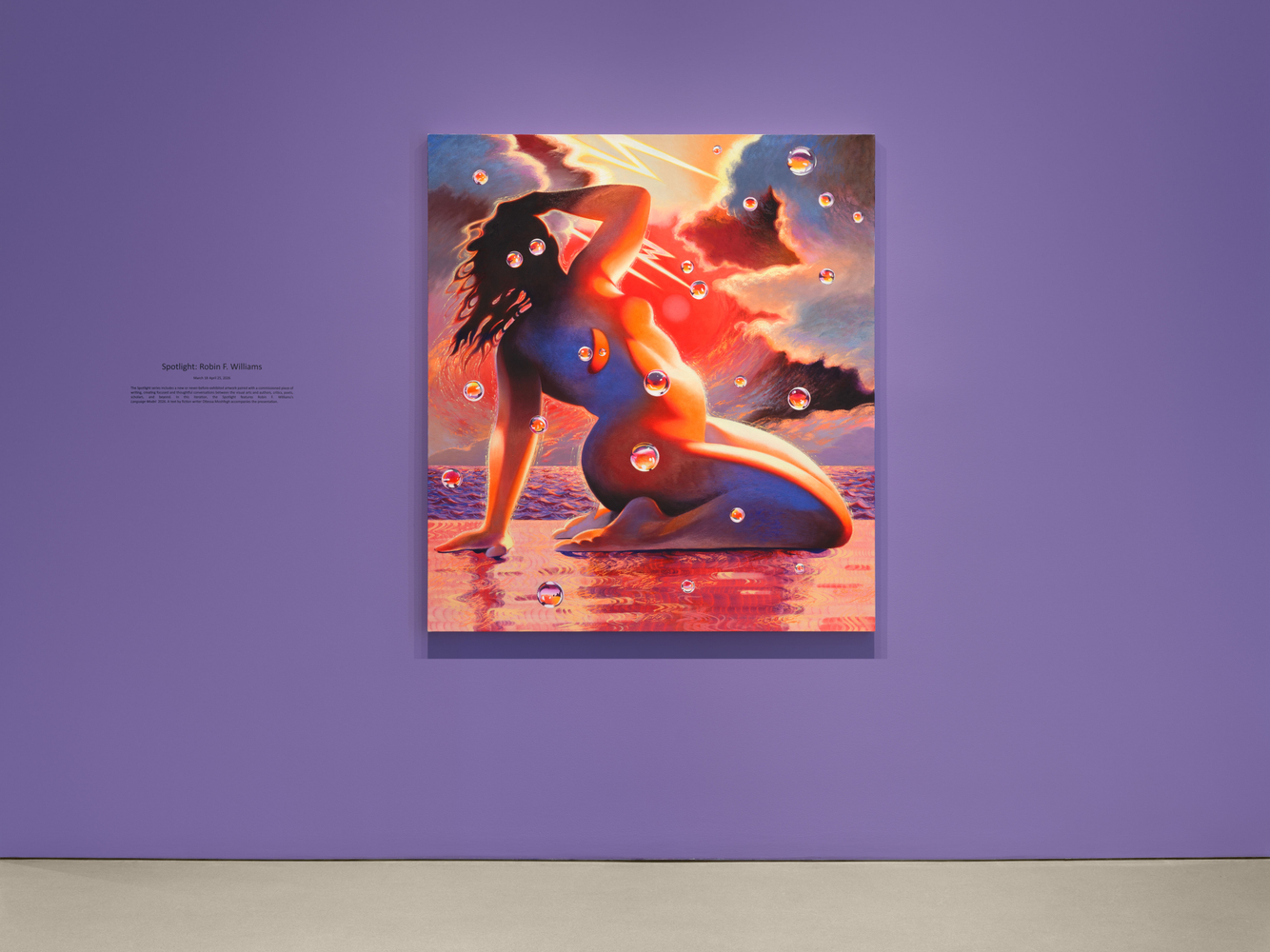
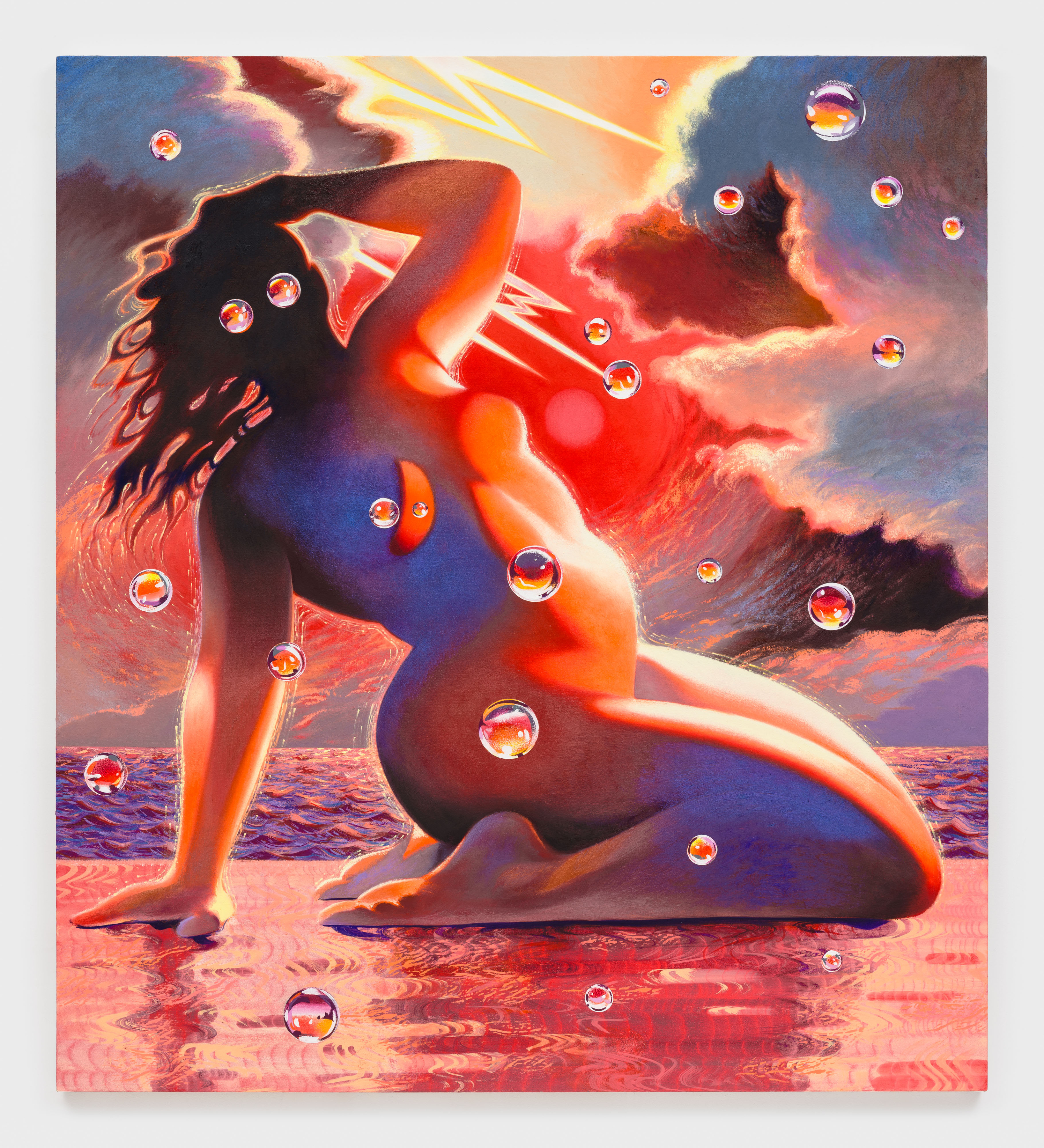
The Spotlight series includes a new or never-before-exhibited artwork paired with a commissioned piece of writing, creating focused and thoughtful conversations between the visual arts and authors, critics, poets, scholars, and beyond. In this iteration, the Spotlight features Robin F. Williams’s Language Model, 2026. A text by fiction writer Ottessa Moshfegh accompanies the presentation.
Robin F. Williams
Language Model, 2026
oil on canvas
60 x 54 ins.
152.4 x 137.2 cm
Language Model
By Ottessa Moshfegh
My mother never taught my big sister the words “scared” or “afraid” because she wanted her daughter to be fearless. Such was the power of language, my mother believed. If there is no word for something, you can’t reach for it. You can’t experience it. You’ll reach for something higher, and so you will rise above your terror. You will be immune to it.
By the time I was conceived, my family had moved from Brussels to Tehran, narrowly escaped a violent revolution, lived briefly with my maternal grandparents in Zagreb, and then immigrated to Newton, Massachusetts. I was the first to be born in America. This “New World” was at such a distance from my family’s torn roots in Croatia and Iran, for a long time it was impossible for me to hold the reality of all three places in my mind without dropping a ball. I inherited no memories of these old worlds but, I’m guessing, a fair share of epigenetic trauma from both sides.
I imagine my in-utero experience much like I imagine death will be: floating through a zone of infinite darkness. It looks like outer space, only there are no stars, no planets. I was surgically removed from my mother’s body by a doctor at Brigham and Women’s Hospital in Boston one day in the spring of 1981. There’s something uncannily triumphant and deranged about that arrival, as if my journey into existence was fated but completely absurd. I somehow boarded a plane by accident. How did I get here? What’s the catch?
I was a quiet kid. If I were to be brash or call attention to myself, I felt, I’d get kicked out of my life and back into that nothingness. And I had no idea what to say, no way to explain this baffling sense of not-knowing, my deep sadness. I couldn’t attach it to anything I had lived. I was supposed to feel lucky that I could begin a life without displacement. And yet I still felt displaced. In 2017 I published a collection of short stories titled Homesick for Another World, still not fully recognizing how the practical circumstances of my early life shaped my sense of belonging. Whether there was a place for me. To be a feeling person seemed impossibly dangerous. Like my sister who did not have the word to describe how she felt when she was scared, I did not have the memories that might have given shape to my psychic composition. I had no effective language to describe how I felt—what triggered what feeling, where it lived, why it lingered.
So I learned to be quietly observant. I studied people. I invented interior voices to narrate their thoughts so that I could intuit the inner workings of their minds. Otherwise the mysteries were too frightening. When I was little, my mother took me to the Museum of Fine Arts in Boston once a week. I was always terrified and fascinated by two works in particular. The first was Degas’s bronze sculpture modeled after the young Belgian dancer Marie van Goethem, Little Dancer Aged Fourteen. She stands upright and hard in a tutu, just under three and a half feet tall. She looked tortured to me, trapped, her arms pulled back behind her as if she were being arrested, forced to bare her heart, an offering to a cruel god. It felt so unfair. The second was Gauguin’s epic painting Where Do We Come From? What Are We? Where Are We Going? So many questions about what it is to be alive. I think of the first Puritans who survived the Atlantic crossing in search of a “New Jerusalem,” who, upon seeing the sand dunes of Cape Cod, were so overcome by the achievement of their reality that some jumped into the water and drowned. There is a little of that terror in the New England landscape—a sense of having survived something that cannot be fully spoken.
I knew what “afraid” and “scared” meant, but fear had no place in my family growing up. Fear was silly. And to laugh at something dismissively was to conquer it. That was just how it was. My fears had to find alternative means of expression. That’s why I write fiction, I think, to get at something secret and deranged that I’m not allowed to talk about. Language still feels so limited when it’s used to describe something ineffable and sensory. Metaphor exists because literal language fails.
I’m often asked why I write unlikeable female characters—women who judge harshly, who are contradictory or violent, desperate, obsessive, delusional, charismatic, occasionally magical. They occupy human bodies that eat, digest, urinate, defecate, menstruate. They sleep, yawn, sweat, change their minds. This seems to shock people more than the upsetting circumstances my characters endure. I think this reflects a primal stupidity in humans: the need for women to be powerful enough to be all-knowing and inexhaustible—like Siri, or a loving God—but controlled enough to step away, let you be the focus, while she becomes nothing, invisible, there only to serve. In that sense, you are her God.
The cognitive dissonance in that arrangement produces anxiety. If mommy’s sad, who will take care of me? We are all babies—petulant and self-centered, unaware of how greedy and difficult we were—and when the certainty of our privileged position is threatened by a different representation of womanhood, we start to sweat. I think my generation carries enormous neurotic anxiety because we grew up sensing that the women who raised us were tasked with the impossible: to be strong and self-directed without destabilizing patriarchy.
I write about men, too. But it is the women who provoke the most scrutiny. We are conditioned to look at a woman and deduce, from her appearance alone, how much of her interiority we are willing to respect, even before she speaks. Who is she? How much do we owe her? How much space does she deserve? And these questions inevitably turn inward: Who am I? How much of my own interior life is it safe to acknowledge? I find it’s very hard to answer these questions honestly.
Robin F. Williams (b. 1984, Columbus, OH) is an artist living and working in Brooklyn, NY. Williams earned a BFA from the Rhode Island School of Design, Providence, RI, in 2006. Recent solo exhibitions include Night Shift, Pace Prints, New York, NY (2025); Good Mourning, P·P·O·W, New York, NY (2024); Undying, Perrotin, Tokyo, Japan (2024); Robin F. Williams: We’ve Been Expecting You, Columbus Museum of Art, Columbus, OH (2024); Watch Yourself, Morán Morán, Mexico City, Mexico (2023). They have been included in numerous group exhibitions, including Enough Already: Women Artists from the Sara M.+ Michelle Vance Waddell Collection, Museum of Contemporary Art Connecticut, Wesport, CT (2025); In the Flesh, Adler Beatty, New York, NY (2025); Two by Two Together, Musée des beaux-arts de Montréal, Montreal, Canada (2024); In New York, Thinking of You (Part I), The FLAG Art Foundation, New York, NY (2023); and Figure Fire Fantasy: Selections from ICA Miami’s Collection, Institute of Contemporary Art, Miami, Miami, FL (2022). Williams is included in art collections worldwide, including the Brooklyn Museum, Brooklyn, NY; Collection Majudia, Montreal, Canada; Columbus Museum of Art, Columbus, OH; Institute of Contemporary Art Miami, Miami, FL; X Museum, Beijing, China.
Ottessa Moshfegh is a fiction writer from New England. Eileen, her first novel, was shortlisted for the National Book Critics Circle Award and the Man Booker Prize, and won the PEN/Hemingway Award for debut fiction. My Year of Rest and Relaxation, Death in Her Hands, and Lapvona, her next three novels, were New York Times bestsellers. She is also the author of the short story collection Homesick for Another World and a novella, McGlue. She lives in Southern California.
Installation view of Spotlight: Robin F. Williams at The FLAG Art Foundation, 2026. Photography by Steven Probert Studio.