
The energy at this year’s Art Basel Hong Kong, particularly during the VIP preview, was noticeably different. The aisles filled quickly, but primarily with attendees from the region, and the brief VIP window felt too short to complete a full lap of the first floor before the crowds rushed in. Whether this was good or bad is a matter of perspective. For seasoned collectors like Alain Servais, it left too little time to properly engage with the art, but for many younger local collectors and enthusiasts, it contributed to the overall sense of excitement and momentum.
There’s been undeniable optimism and enthusiasm in Hong Kong this week—especially compared to last year. Much of it traces back to long-term public investments in the city’s now expansive, top-tier institutional system, anchored by M+ and the West Kowloon cultural district, as well as a surge of experimental arts initiatives across the city’s new galleries, satellite fairs and salons. “Hong Kong is back, with a refreshed energy,” director Angelle Siyang-Le told Observer at the opening. While the ongoing war in Iran raises concerns about security and sustainability, she believes that Asia, and particularly mainland China, has grown resilient in recent years, to the point of almost seeming isolated from world events, even as dealers this year have had to cope with rising costs and shipping issues caused by the conflict.
Art Basel Hong Kong in 2026 is notably more context-specific, with more than half of the 240 galleries hailing from the APAC region, aligning with the fair’s role as a key platform for bridging the art worlds of Europe and Asia and offering valuable visibility for emerging voices in the local ecosystem. Collectors at the VIP preview were predominantly from the region, with strong representation from Hong Kong, mainland China, Taiwan, Korea, Japan and Southeast Asia, joined by a smaller group of relentless globe-trotting international collectors such as Servais and Patrizia Sandretto Rebaudengo.
The rhythm of the fair felt distinct from both Western art fairs and past editions of Art Basel in Asia. Visitors seemed to stop and engage more, taking time to contemplate and converse rather than rushing to buy. According to Siyang-Le, this market is unlikely to return to pre-COVID speculative dynamics. Younger collectors entering the scene in Hong Kong and across Asia are adopting a more deliberate approach, building direct relationships with galleries and artists, conducting their own research and focusing on the long-term. “Back then, there was a lot of buying with your ears. Now, with younger generations coming in, collecting has become less impulsive and more purposeful,” she said, pointing out that the shift to legacy building is healthier in the long run.
By the evening of the first day, dealers were reporting steady sales across a wide range of price points, from entry-level works to pieces exceeding $3 million, setting an optimistic tone for the rest of the fair. All the major blue-chip galleries were present this year, most with targeted presentations tailored to regional tastes and recent artist exposures. Clusters of Western mega-galleries on the left side of Level 1 showed marked confidence, offering a large selection of high-priced works signaling renewed trust in Hong Kong as a hub for regional collectors.
Among the top sales, David Zwirner reported placing a 2006 painting by Liu Ye for $3.8 million, along with works by Marlene Dumas ($3.5 million), Michaël Borremans ($1.1 million), Yoshitomo Nara ($900,000) and Raymond Pettibon ($680,000). Sculptural works also sold well, particularly for work by in-demand artists like Andra Ursuța, whose Phantom Mass (2025) sold for $400,000, and Huma Bhabha, whose sculptural piece sold for $300,000. The gallery also placed works by Mamma Andersson ($400,000), Lucas Arruda ($250,000) and two pieces by Yu Nishimura priced between $40,000 and $120,000. Multiple works by Walter Price sold with prices ranging from $30,000 to $90,000, coinciding with his solo exhibition at David Zwirner Hong Kong.
Hauser & Wirth, which also has a strong regional presence, focused on artists with established followings. Among the top sales were a four-panel gouache and watercolor composition by Louise Bourgeois dedicated to Baudelaire, which sold for $2.95 million, and her Couple (2002), which went for $2.2 million to an Asian foundation. The gallery also sold George Condo’s Prismatic Head (2021) for $2.3 million to a private Asian collection, alongside works by Rashid Johnson, Avery Singer, Qiu Xiaofei, Flora Yukhnovich and Cindy Sherman, ranging from $175,000 to $750,000. Lee Bul’s Untitled (“Infinity” Wall) (2026) was placed with a private museum for $275,000, while another mixed-media work by the artist was acquired by a private collector for $260,000. Marc Payot, the gallery’s president, noted the significant increase in both quality and attendance at this year’s fair, highlighting the energy generated by great conversations and renewed interest in the dialogue between historic and contemporary art. “It’s inspiring to see how this continues to grow and develop,” he told Observer.
Other early multi-million-dollar sales included Pablo Picasso’s Le peintre et son modèle (1964), sold by Bastian for €3.5 million, and Waddington Custot placements of a $2.8 million abstraction by Zao Wou-Ki and a work by Chu Teh-Chun for $1.3 million. The highest-priced work at the fair this year is a $13.3 million Modigliani brought by Pace, perhaps to capitalize on the momentum created by the just-published catalogue raisonné from Institut Restellini, 30 years in the making and ahead of a 2027 exhibition the gallery is jointly organizing. “The fair is off to a great start, we’ve already sold a major Calder mobile, and placed a number of important works by artists including Wang Guangle, Mao Yan, Zhang Xiaogang, Alicja Kwade and Anicka Yi, who has just joined us at Pace,” Marc Glimcher shared.
Lehmann Maupin, Lee Bul’s first international gallery, placed two of the artist’s early 2000s works with private collectors in Europe and Asia, priced between $200,000 and $300,000. During the preview, the gallery sold more than 15 pieces, including signature wood sculptures by Kim Yun Shin acquired by an Asian museum and a private European collector, for $100,000-$150,000 each. Kim’s retrospective is currently on view at the Hoam Museum of Art, in what is the first solo show by a living female Korean artist at the museum. Works by Do Ho Suh and Anna Park’s Queen of Hearts (2026) were sold to collectors in Asia, with Park’s piece priced at $20,000-$25,000 ahead of her solo show in London. A standout in the booth was Malaysian-British artist Mandy El-Sayegh’s vibrant wall installation of gridded collage canvases combining poetry with private and collective memory. Featured in the Kabinett section, all three works were quickly placed in private collections in Asia, priced between $70,000 and $90,000. (El-Sayegh is currently showing at SpaceK in Seoul.)
“Hong Kong’s art market is clearly in a steady phase of recovery, with renewed energy across the fair and city,” said david maupin, emphasizing the region’s ongoing importance to their business and the strong demand from local collectors for works by Asian artists in their roster, including Suh, Kim Yun Shin, Anna Park and Liu Wei, ahead of his upcoming commission at the Metropolitan Museum of Art this fall.
White Cube reported several early sales in the five- and six-figure ranges, led by Tracey Emin’s emotionally charged Take Me to Heaven (2024), which sold for £1.2 million to an Asian collector, following the momentum of her ongoing survey “A Second Life” at Tate London. The gallery also sold a work by Kiefer and two Antony Gormley cast iron sculptures, priced at £500,000 and £300,000. Other notable sales included Etel Adnan’s tapestry ($180,000), an Isamu Noguchi bronze plate ($150,000) and works by Ilana Savdie ($125,000), Marina Rheingantz ($150,000), Howardena Pindell ($325,000) and Alia Ahmad ($125,000). Shao Fan’s ink work, a new piece by Louise Giovanelli (£35,000) and Emmi Whitehorse’s mixed-media work ($250,000) were also sold.
Gladstone likewise closed several high-profile sales across various media, led by Alex Katz’s monumental Flowers 1 for $1.3 million. Additional sales included Matthew Barney’s new graphite on paper piece ($100,000), two works on paper by Elizabeth Peyton ($125,000 and $250,000) and works by David Rappeneau ($32,000), Rachel Rose ($25,000) and two paintings by Rirkrit Tiravanija on newspaper on linen, each sold for $160,000. Following a stellar year of both institutional and market attention, two inkjet dye transfers on paper by Robert Rauschenberg also sold for $110,000 each. Other acquisitions on the contemporary side included works by Andro Wekua (€110,000) and Brook Hsu ($26,000), along with two paintings by Arisa Yoshioka for $22,500 each.
Thaddeus Ropac secured a €460,000 sale on the first day of the fair when a Chinese institution bought a gestural abstraction by Martha Jungwirth. Other early acquisitions included works by Megan Rooney (£280,000) and Oliver Beer (£55,000), and a tactile canvas by young Korean talent Heemin Chung, which sold for $24,000.
Despite no longer having a physical presence in Hong Kong after closing its K11 space, Perrotin remains a major player in the Asian art scene. On the first day of the fair, approximately 70 percent of the booth was sold, led by several high-value placements of works by Takashi Murakami ($600,000-$800,000). The gallery sold out its solo presentation of Mehdi Ghadyanloo’s oil paintings (€160,000-€180,000), as well as additional works by Claire Tabouret and Emily Mae Smith. Sections dedicated to Maurizio Cattelan and Lee Bae also sold out, with works priced between $100,000 and $120,000. Lauren Tsai and Steph Huang drew significant attention, with Huang in particular attracting strong institutional interest.
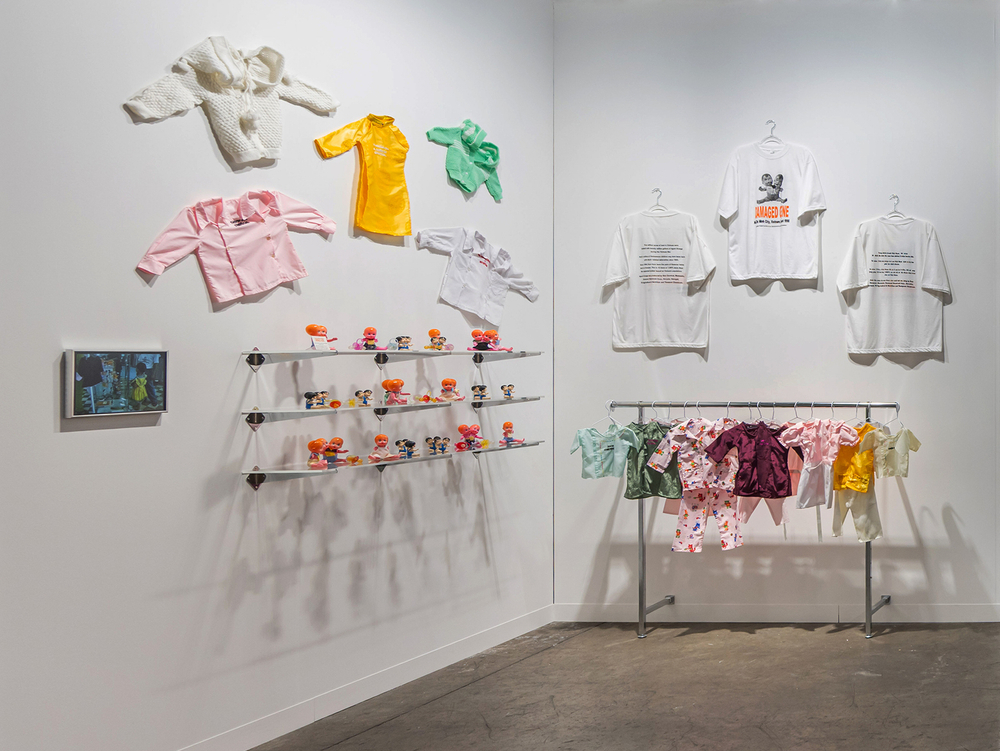
Museums and foundations from the region were notably active, highlighting the growing importance of Southeast Asian institutions. Early in the day, P•P•O•W sold its Kabinett presentation featuring Damaged Gene (1998), a historically significant installation by Dinh Q. Lê, to a prominent Asian foundation. First shown at the Saigon Trade Center amid Vietnam’s legal battles with chemical companies responsible for wartime defoliants, the work—which filled the space with handmade clothing and toys for conjoined twins—powerfully references dioxin-related birth deformities. The work has since been shown at the Asia Society (2005), the Mori Museum of Art (2015) and the Nguyễn Art Foundation (2022).
Returning to Art Basel Hong Kong for the second time, Berry Campbell attracted plenty of attention with its presentation of long-overlooked American abstraction, particularly by women artists. “We’ve witnessed an incredible energy and a palpable buzz on the fair’s opening day, which has translated into a strong lineup of sales by artists such as Elaine De Kooning, Lynne Drexler, and Alice Baber,” co-owner Christine Berry told Observer. The six-figure sale of de Kooning’s Basketball #5 (1981) ahead of the artist’s upcoming exhibition at the New York gallery next fall confirms the continued market strength of women Abstract Expressionists in Asia. “Art Basel Hong Kong remains a critical platform for engaging collectors from the region and advancing our dedication to championing women artists on a global scale,” Berry added. Additional sales included Lynne Drexler’s Wax and Crayon on Paper ($40,000) and Alice Baber works ($275,000 and $25,000).
Demand was particularly strong for both blue-chip and emerging regional artists, with Korean gallery Johyun reporting 37 sales ranging from $9,000 to $180,000. Works by Dansaekhwa artists such as Park Seo-Bo, Kim Taek Sang and Lee Bae were among the top sellers. Jaewoo Choi, president of Johyun Gallery, told Observer that Art Basel Hong Kong remains a key platform for the gallery: “We had the opportunity to meet a diverse range of international collectors, including representatives from major Japanese foundations and leading Southeast Asia–based collectors. These encounters provided a meaningful opportunity to further expand our global collector network.”
Korean galleries Hakgojae and PKM also reported strong sales. Hakgojae sold works by Joung Young-Ju ($66,000), Jiang Heng ($55,000), and Park Gwangsoo ($3,600), while PKM reported a higher volume of inquiries from serious collectors than last year. On day one, it sold two works by Yun Hyong-keun ($370,000 and $90,000) and a piece by Wonwoo Lee ($6,000). The gallery also saw significant interest in works by Yun Hyong-keun, Yoo Youngkuk, Chung Hyun and Lee Geunmin. Three visceral abstractions by a new addition to the gallery’s roster, Keumin Lee, drew particular attention.
Tina Kim Gallery, which is based in the U.S. but focuses on Korean artists, sold a significant trapunto painting by Pacita Abad ($250,000-$300,000), two works by Ha Chong Hyun ($180,000 each) and a Kim Tschang-Yeul painting ($40,000). Suki Seokyeong Kang’s sculptural work in the “Encounters” section sold for $200,000, and two additional pieces were placed on hold by an Asian institution. The gallery also sold two textile works by Lee ShinJa—one to an Asian institution ($150,000-$200,000) and the other to a private collector ($70,000). Two tulip petal collages by Jennifer Tee also found homes, one with an institution ($30,000-$50,000) and the other with a private collector ($8,000).
On the contemporary side, Shanghai’s Hive Gallery reported multiple sales by top-selling names like Yuan Fang and Fu Liang. Veteran Hong Kong powerhouse Pearl Lam Projects sold works by Alimi Adewale, Su Xiaobai and Qiu Anxiong (in the $20,000- $250,000 range). Also from Shanghai, BANK Gallery had a strong first day with a solo booth of Jiang Cheng’s new paintings. Although Jiang has become popular in the U.S., with notable museum acquisitions including ICA Miami, this presentation aimed to reintroduce him to Asian collectors. “We are thrilled with the results,” founder Mathieu Borysevicz told Observer, reporting a successful first day with steady sales. He acknowledged that while the energy was lively, the atmosphere was more measured than in previous years. “I see this as a healthy, positive sign, moving away from market speculation to meaningful connections.”