
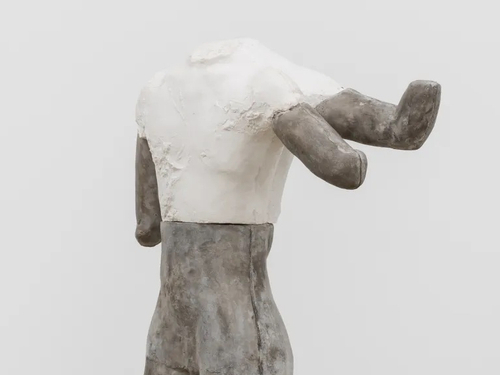
Phnom Penh, Venice, Shanghai, Basel—every time Yu Ji and I met over the past four years, we were in a different city. At other times, she has traveled with her sculptures to stage solo exhibitions in London, Orange County, and Berlin. The artist, who was born in 1985 in Shanghai, has actively chosen an itinerant existence to reach beyond familiar horizons of both life and art, before eventually establishing a base in New York in late summer 2024. “Overcoming greater difficulties has always been my way forward,” Yu Ji told me when we sat down in her studio in Chinatown. On March 6, Yu Ji’s first solo presentation in New York opens at P·P·O·W, following commissions for the High Line (2022) and SculptureCenter (2025).
The exhibition’s title, “Origin of the Tiger,” comes from a Khmer folk tale, which Yu Ji reads as a metaphor for the origins of sculpture. The story recounts how a king, seeking to protect his kingdom, traveled with his queen, the royal astrologer, and four chief ministers to a distant land in search of magical practices. What they learned was transfiguration. To survive their return through the forest, the astrologer suggested that they metamorphose into a tiger, with each person assuming a different bodily function: the ministers as limbs, the astrologer as tail, the queen as body, and the king as head. This, according to the tale, is how tigers came into the world.
This story sets the tone for Yu Ji’s navigation through a multidisciplinary practice. Her work encompasses cast and molded sculpture, installation, organic objects, and durational works employing performance, video, and sound. Her ongoing “Flesh in Stone” series—begun in 2012 and among her most recognizable works—presents cement body parts. These life-size sculptures are fixed to walls with metal supports, placed on chairs to register bodily scale, or positioned on the floor in juxtaposition with larger compositions. At times, groups of works are organized around joined tables, on top of which are placed perishables preserved in lead, resin, or plaster. She has also worked collaboratively—staging performances and devising a self-organized residency in Phnom Penh in 2023 with four artists from different regions.
“Origin of the Tiger” represents Yu Ji’s effort to establish an approach to sculpture that is not rooted in the Hellenic tradition: Parts serve different functions to form a collective, rather than reducing excess so that a singular form emerges. Her recent works challenge classical paradigms not only through processes of molding and assembly, but also through a rethinking of how human existence in sculpture might achieve, as she told me, “the immovable that resists change.”
Yu Ji’s work moves from China’s post-Soviet academic legacy toward a humanistic concern rooted in realism. Informed by her study of Greek ruins, Yu Ji considers the European tradition of the body in motion while embracing legacies from across the Asian continent. In this show, the forty-year-old artist finds a formal resolution to these threads, returning to fundamental questions of human life.
— Li Qi
As a sculptor, I was always drawn to Khmer dance—so was Auguste Rodin, in 1906, when the Royal Ballet of Cambodia traveled through France with King Sisowath, appearing at a series of international expositions and bringing Khmer culture overseas for the first time. Rodin caught the act, and was captivated. Yet the sixty-six-year-old artist did not respond through sculpture—he turned to drawing. This shift intrigued me. I wanted to understand what he saw in the dancers’ bodies, and whether he had left any clue as to how the body in dance might be transformed into the body in sculpture. Eventually, I realized that this was precisely what was absent from Rodin’s illustration.
Rodin’s watercolored drawings—more than 150 of them—translate Khmer dance into line and velocity by catching the dancers’ limbs midair, aligning them with a modern sculptural tradition that privileges movement as form. Yet what I encounter in Khmer dance is not dynamic action but a suspension that harvests both the momentum and the singularity of time collapsing. This difference is not a stylistic divergence but a philosophical one.
From late 2023 through 2024, I lived in Phnom Penh, the Cambodian capital, renting an apartment across from the National Museum of Cambodia, where I encountered Krishna Lifting Mount Govardhan (ca. 600). The sculpture depicts Krishna, the protector, raising a mountain with his left arm to shield cowherds from the wrathful storm unleashed by Indra—a pivotal motif in Khmer art. It was a period of turmoil in my life, and somehow Krishna emerged as a spiritual pillar. I returned to the sculpture repeatedly, asking myself what it was that kept calling me back. In time, this call became the cornerstone of my exhibition “Origin of the Tiger.”
My understanding of the body is modular. When I refer to the body, I think of a whole composed of specific parts, or of several parts in relation, rather than a body that is complete only when all parts are present. The corporal forms I create are open; I generally resist giving them a clear identity or fixed referential markers. Over the past several years, as I moved between cities, my sculptural practice could not unfold within a stable environment. I often packed body parts molded in one city into suitcases, carried them to the next place, continued working, completed a section, rebuilt crates, and moved on again. Now, in New York, the legs, torso, and arms—cast in cement and plaster at various locations during my travels—have been assembled into a life-size sculpture measuring over six feet tall, echoing Krishna Lifting Mount Govardhan. This work is my response to the Khmer body and its dance, one of the most significant influences on my practice.
At times, Khmer dance strikes me as sculpture in motion. The sculptural body seems animated, imbued with a powerful sense of faith, as if the human figure were made from stone. This understanding appears to stem from an ancient source, where body and matter are not merely symbolically alike, but are fundamentally continuous. When watching Khmer dance, I often perceive a sense of gravity rather than lightness. It is as though a block of stone were being transposed. The force is directed downward, grounded and compact. It’s this material quality that I find sculptural.
In my sculpture, I want to shape not the human body, but flesh. The anatomically faithful representation of the human body in sculpture is a principle rooted in Western tradition. Flesh, by contrast, feels closer to me as an idea. It is an Eastern notion, one I have explicitly invoked in earlier series such as “Flesh in Stone.” Flesh encompasses softness; it is a volumetric expression of form articulated through mass and density. The freestanding figures that recur in Khmer statuary have a pronounced density and solidity. Whether male, female, or divine, these bodies convey force, belief, and energy.
Perhaps this exemplifies how the East perceives the body. I recall a conversation with Prumsodun Ok, founder of Cambodia’s first gay dance company, whose work transcends the gender conventions of classical Khmer dance. We shared a fascination with the Krishna sculpture—one of the canonical works of Khmer statuary—and he told me that he often brings his dancers to study Khmer sculpture as a reference for how to situate their bodies between movements. We arrived at a shared understanding: The body moves with the aim of reaching a threshold of stillness; it is at this moment that dance becomes sculpture. This, fundamentally, is where our understanding of body and dance diverges from Rodin’s.
Rodin’s attraction to Khmer dancers was driven by a sense of exotic curiosity. His drawings demonstrate that he was fully aware of how radically this system of bodily display differed from Western conventions, a situation comparable to how Japanese ukiyo-e prints entered post-Impressionist painting. One contemporary report writes of how Rodin was “struck by the timeless and universal nature of the movements of this dance.” I recognize this rhetoric, yet I find little evidence of it in his drawings. This discrepancy clarifies my fundamental departure from Rodin’s paradigm, which lies precisely in how “timelessness” and “universality” are understood. Within a Western framework, eternity is often conceived as perpetual, unstoppable change—an ideology of movement. In many Eastern traditions, by contrast, eternity is the immovable that resists change, a condition of suspension extending across infinity. It is from this understanding that my conception of sculpture emerges.
“Yu Ji: Origin of the Tiger” is on view from March 6 to April 11, 2026, at P·P·O·W, New York.