


Martin Wong

Martin Wong: Chinatown USA is the first US monographic museum exhibition since 2017 of Chinese American artist Martin Wong (1946–1999). The exhibition features over 100 paintings, sculptures, drawings, and photographs illustrating Wong’s idiosyncratic urban realism, his innovative approach to technique and form, his rich surfaces, and the inspiration he took from astrology, architecture, and various modes of language. Curated by Yasufumi Nakamori, PhD, with Ashley Janke, Assistant Curator, Wrightwood 659, the exhibition is presented by Halsted A&A Foundation.
Martin Wong: Chinatown USA traces the development of the work of the queer painter and poet, highlighting Wong’s connection with the art and culture of Asia, in particular through his collecting of pre-modern Asian art and antiquities and his explorations of the Chinatowns of New York and San Francisco from 1970 through the 1990s. A large portion of the exhibition is devoted to his Chinatown paintings, which were the subject of a major exhibition titled Chinatown USA presented at P·P·O·W in New York City and the San Francisco Art Institute in 1993.
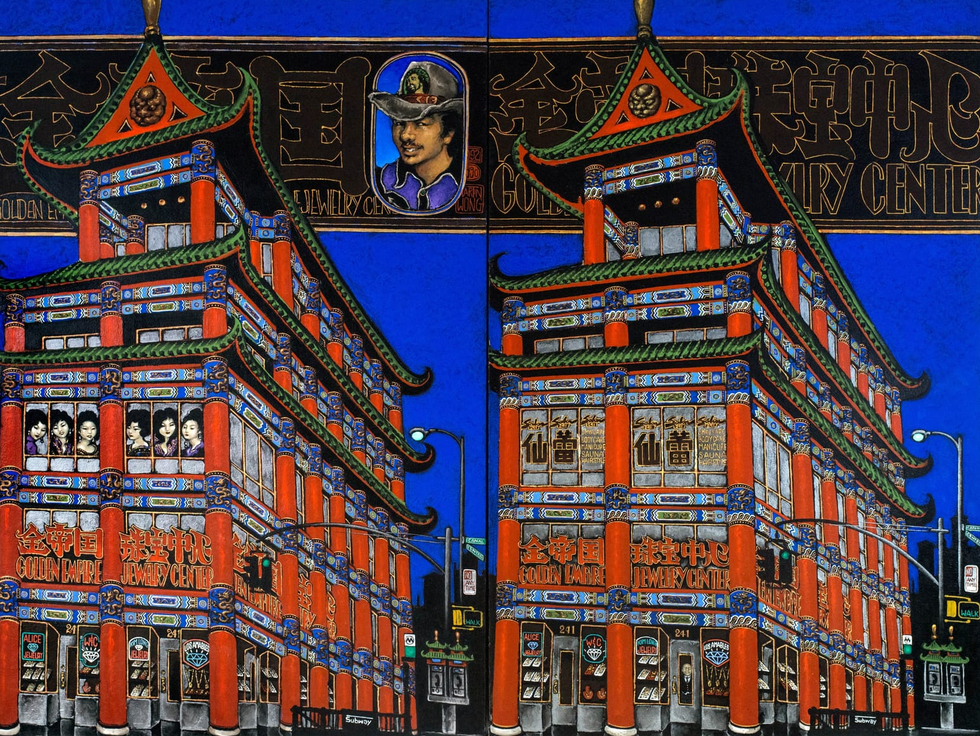
These works depict notable architecture such as the Chinese pagoda-style building at 241 Canal Street, icons including actor Bruce Lee and Peking opera performer Mei Lanfang, festivities like the Chinese New Year Parade, and street scenes. The exhibition also explores Wong’s interest in counterculture communities (such as Puerto Rican poets and graffiti artists) and language through his poetry and American Sign Language paintings. The latter are presented alongside a small selection of works by artists of the modern graffiti movement from Wong’s personal collection, which he donated to the Museum of the City of New York in 1994. Wong died in 1999 at the age of 53 from an AIDS-related illness.
Martin Wong: Chinatown USA is accompanied by a fully illustrated catalogue published by Halsted A&A Foundation and Gregory R. Miller & Co. Edited by Yasufumi Nakamori, it includes six essays by leading scholars Solomon Adler, Lisa Hsiao Chen, Mark D. Johnson, Vivian Li, Margo Machida, and Lydia Yee.
Martin Wong
Canal Street, 1992
acrylic on canvas
72 x 96 ins.
182.9 x 243.8 cm
Martin Wong
Clones of Bruce Lee, 1992
acrylic on linen
45 x 55 ins.
114.3 x 139.7 cm
Martin Wong
Chinese New Year's Parade, 1992-94
acrylic on linen
84 x 120 1/2 ins.
213.4 x 306.1 cm
Martin Wong
Chop Suey Sundae, 1992
acrylic on canvas
52 x 30 ins.
132.1 x 76.2 cm
Martin Wong
Tibetan Porky, 1975-78
acrylic on canvas
60 x 48 ins.
152.4 x 121.9 cm
Martin Wong
Untitled (Chinese Consolidated Benevolent Association), c. 1992
acrylic on canvas
72 1/2 x 36 1/4 ins.
184.2 x 92.1 cm
Martin Wong
Mark Twain, c. 1982
acrylic on canvas
48 x 59 ins.
121.9 x 149.9 cm
Martin Wong
Blue Beard the Pirate, 1982
acrylic on canvas
71 x 48 ins.
180.3 x 121.9 cm
Martin Wong
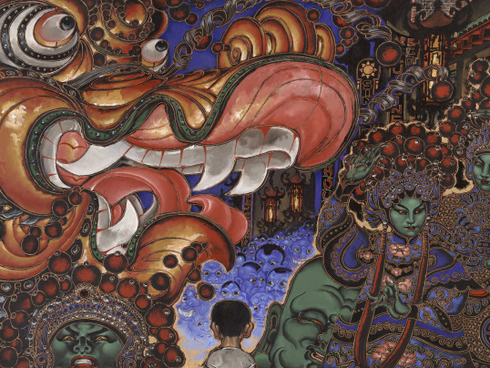
Untitled (Dragon and children), c. 1976
acrylic on canvas
48 x 60 ins.
121.9 x 152.4 cm
Installation view of Martin Wong: Chinatown USA, at Wrightwood 659, 2026. Photo by Shanti Knight.
Installation view of Martin Wong: Chinatown USA, at Wrightwood 659, 2026. Photo by Shanti Knight.
Installation view of Martin Wong: Chinatown USA, at Wrightwood 659, 2026. Photo by Shanti Knight.
Installation view of Martin Wong: Chinatown USA, at Wrightwood 659, 2026. Photo by Shanti Knight.
Installation view of Martin Wong: Chinatown USA, at Wrightwood 659, 2026. Photo by Shanti Knight.
Installation view of Martin Wong: Chinatown USA, at Wrightwood 659, 2026. Photo by Shanti Knight.
Installation view of Martin Wong: Chinatown USA, at Wrightwood 659, 2026. Photo by Shanti Knight.
Installation view of Martin Wong: Chinatown USA, at Wrightwood 659, 2026. Photo by Shanti Knight.
Installation view of Martin Wong: Chinatown USA, at Wrightwood 659, 2026. Photo by Shanti Knight.
Installation view of Martin Wong: Chinatown USA, at Wrightwood 659, 2026. Photo by Shanti Knight.
Installation view of Martin Wong: Chinatown USA, at Wrightwood 659, 2026. Photo by Shanti Knight.
Installation view of Martin Wong: Chinatown USA, at Wrightwood 659, 2026. Photo by Shanti Knight.
Installation view of Martin Wong: Chinatown USA, at Wrightwood 659, 2026. Photo by Shanti Knight.
Installation view of Martin Wong: Chinatown USA, at Wrightwood 659, 2026. Photo by Shanti Knight.
Installation view of Martin Wong: Chinatown USA, at Wrightwood 659, 2026. Photo by Shanti Knight.
Installation view of Martin Wong: Chinatown USA, at Wrightwood 659, 2026. Photo by Shanti Knight.
Installation view of Martin Wong: Chinatown USA, at Wrightwood 659, 2026. Photo by Shanti Knight.

With a new season ahead, V reading ahead on the literary releases worth knowing, spotlighting the fantastical new titles making their way to bookstores this fall.

Raised in San Francisco’s Chinatown, visual artist Martin Wong (1946–1999) deserves to be far better known.

Wong left us with a lot of questions unanswered, and I think that’s the allure of his work. He is confusingly complex and fascinating, like how he was fascinated by the world he was in.

Tucked away at a small institution in Chicago is an eye-opening show by beloved New York artist Martin Wong, a self-taught artist of Chinese-American descent who recorded a bombed-out Lower East Side and heroized his Asian and Latino contemporaries who lived there.

“Martin Wong: Chinatown USA,” Chicago's first exhibition devoted to Wong, is on view through July 18 at Wrightwood 659.

A joint biography of Peter Hujar and Paul Thek, a catalog on Martin Wong’s Chinatowns, Catherine Opie’s portraiture, queer nightlife through the ages, and more.

If all the world’s a stage, then Martin Wong, who died from AIDS at the age of 53 in 1999, was never a mere player: he was also set designer, director and costumer.

'Chinatown USA’ and ‘Popeye’ open this weekend in Chicago and New York.

Martin Wong grew up in San Francisco near Chinatown. His Chinese-born father died when the artist was four years old. Wong was raised by his Chinese American mother and Chinese Mexican American stepfather.

For decades, P·P·O·W has been a careful steward of Wong’s legacy as the representative of his estate.

In this news rundown, Wrightwood 659 and P·P·O·W are highlighted for their upcoming exhibitions of the work of Martin Wong.
Martin Wong’s mesmerizing Chinatowns, Mindy Rose Schwartz’s subversion of craft, Nate Millstein’s tin ceilings, and so much more.
The Asian-American artist Martin Wong was the ultimate outsider. Born in Portland, Oregon, he was raised in San Francisco’s Chinatown.